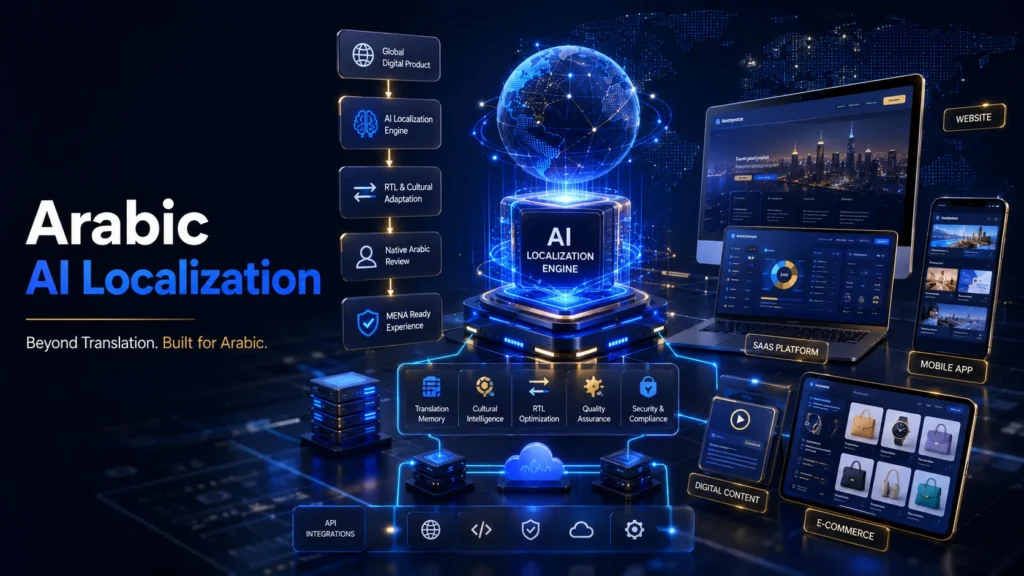
FastTrans AI Software Localization Services help technology companies launch Arabic versions of their applications with linguistic precision and cultural authenticity. Whether you’re adapting English software for MENA markets or localizing French, German, or Spanish platforms for Arabic users, FastTrans combines AI efficiency with native Arabic expertise to deliver software that feels locally built, not translated.
What is FastTrans AI Software Localization for Arabic
FastTrans AI Software Localization adapts software interfaces, code strings, documentation, and user experiences for Arabic-speaking audiences across the Middle East and North Africa. This isn’t basic translation—it’s comprehensive adaptation of UI elements, RTL formatting, date and currency conventions, cultural references, and technical terminology to match how Arabic users actually interact with technology.
AI-Accelerated Translation for Software Strings
FastTrans AI processes thousands of UI strings, error messages, and in-app text while maintaining context and technical accuracy specific to Arabic software environments.
Native Arabic Linguistic Review
Every localized element gets reviewed by native Arabic speakers with software domain expertise who understand both technical requirements and regional user expectations across Gulf, Levantine, and North African markets.
RTL Layout and Formatting Optimization
FastTrans handles right-to-left interface adaptation, Arabic font rendering, text expansion management, and bidirectional text flows that break when not properly implemented for Arabic scripts.
Why Cultural Accuracy Matters in Arabic Software Localization
Incorrect RTL formatting makes software literally unusable for Arabic readers.
Generic translations miss regional dialect preferences across different Arab markets.
Poor localization drives Arabic users to competitor products with better experiences.
Cultural missteps in Arabic interfaces alienate entire market segments permanently.
Technical terminology errors cause support nightmares for Arabic-speaking customer service teams.
Trusted by Industry Leaders
PDF
XML
PSD
InDesign
FrameMaker
Specialized Arabic Software Localization Services Tailored to Your Technology Stack
Different software platforms face different Arabic localization challenges. FastTrans handles mobile apps with space-constrained Arabic UI, enterprise SaaS with complex terminology, and consumer applications requiring culturally resonant Arabic experiences. Here’s what FastTrans delivers for specific software categories.
FastTrans Arabic Software Localization Capabilities for AI-Powered Translation
FastTrans handles the complete spectrum of software elements requiring Arabic localization—from front-end user interfaces to back-end documentation. Here’s what gets localized:
Arabic UI Strings
Arabic Menu Items
Arabic Dialog Boxes
Arabic Error Messages
Arabic Button Labels
Arabic Tooltip Text
Arabic Settings Panels
Arabic Onboarding Screens
Arabic Help Documentation
Arabic API Documentation
Arabic Release Notes
Arabic User Manuals
Arabic Installation Wizards
Arabic License Agreements
Arabic Privacy Policies
English-Arabic Software Strings
French-Arabic Application Text
German-Arabic Interface Elements
Spanish-Arabic Platform Content
Multilingual Software Packages
Why Choose FastTrans for AI Software Localization Services
FastTrans brings specialized Arabic software expertise that generic translation platforms can’t match. The difference shows up in culturally authentic interfaces, technically accurate terminology, and RTL implementations that actually work.
Native Arabic Software Translators with Technical Expertise
FastTrans translators aren’t just Arabic speakers—they’re software users who understand technical terminology, UI conventions, and how Arabic-speaking users navigate applications across different Arab regions.
AI Translation Memory for Software Consistency
Repetitive UI elements get translated once, then reused automatically across your software. FastTrans AI maintains consistency for terms like “save,” “cancel,” “settings”—critical for Arabic user interfaces where terminology inconsistency causes confusion.
Context-Aware Localization for Software Strings
Short UI strings like “Cancel” or “OK” translate differently depending on context. FastTrans AI analyzes where strings appear in your software to deliver contextually appropriate Arabic translations that make sense in each screen.
Specialized Arabic Glossaries for Software Terminology
Your product has unique terminology. FastTrans creates custom Arabic glossaries for your software vocabulary, then enforces consistent usage across every UI string, help article, and documentation file for coherent Arabic user experiences.
ISO 9001
Certified Mgmt
Officially Certified
by EGAC and IAF
IAF Certified
EGAC Certified
Certified
Trusted by Product Teams and SaaS Platforms Worldwide.
Leading software developers and global corporations rely on FastTrans for Arabic AI software localization needs. We are the silent partner behind high-converting platforms, culturally resonant user interfaces, and successful digital scaling across the Middle East, delivering speed and local relevance when it counts most.
FastTrans handles translation and localization services for Arabic content across the Gulf, Levant, and North Africa, and every major language pair paired with Arabic. English-Arabic, French-Arabic, German-Arabic, Spanish-Arabic—one standard, applied consistently.
Transparent Pricing for Arabic Translation and Localization
Pricing runs per word, per project, or by volume tier depending on the work. No hidden fees added after the quote — what’s estimated is what gets billed.
The Essential
Al-Verified
$0.060
/word
Neural machine translation fully post-edited by a native linguist
Editorial responsibility taken for the output
Translation memory and glossary are applied
Every segment is reviewed — nothing ships unread
Not suitable for:
Certified documents, legal or medical content, marketing copy, or anything a regulator will read
SaaS companies, mobile developers, and enterprise software teams trust FastTrans for Arabic localization that helps their applications succeed in MENA markets. Clients report faster time-to-market, higher Arabic user satisfaction, and fewer post-launch localization issues compared to previous translation approaches.
Posted on Google
waad oa
Trustindex verifies that the original source of the review is Google.
سرعة واحترافية
Posted on Google
ahmed farouk
Trustindex verifies that the original source of the review is Google.
شركة ممتازة
Posted on Google
محمد يوسف
Trustindex verifies that the original source of the review is Google.
خدمه ممتازه ومعامله راقيه
Posted on Google
Farah Farah
Trustindex verifies that the original source of the review is Google.
خدمة ممتازه
Posted on Google
Abad Abad
Trustindex verifies that the original source of the review is Google.
مكتب ترجمة محترم وسريع في التسليم ومنتظم في مواعيده وخبير جداً في ششهادات التخرج
Posted on Google
Alaa Hany
Trustindex verifies that the original source of the review is Google.
Good service
Posted on Google
Mahmoud Marshmellow
Trustindex verifies that the original source of the review is Google.
بجد شركه محترمه وفعلا الترجمه جيده والتوثيق معتمد بجد أشكركم جدا علي مجهودكم 🙏
Posted on Google
Mohab Asayed
Trustindex verifies that the original source of the review is Google.
Trusted by
Legal Departments and Law Firms Worldwide
Major law firms and global corporations rely on FastTrans for AI translate legal document needs. We are the silent partner behind successful cross-border mergers, international litigation victories, and compliant market entries across the Middle East, delivering reliability when it counts most.
Common questions about localizing software for Arabic markets, RTL implementation, and AI-powered translation workflows. Here’s what technology teams ask most.
Need more help?
Our support team is available 24/7 for technical assistance.
Does FastTrans handle both Modern Standard Arabic and regional dialects for software?
FastTrans primarily uses Modern Standard Arabic for software interfaces—it’s universally understood across Arab regions. For marketing content or region-specific features, dialect customization is available.
Can FastTrans localize software from languages other than English into Arabic?
Yes. FastTrans handles French-Arabic, German-Arabic, Spanish-Arabic, and 120+ other language pairs for software localization. English-Arabic is the most common, but the process works identically for any source language.
How does FastTrans handle RTL layout issues in Arabic software localization?
FastTrans provides RTL implementation guidance, tests Arabic layouts across devices, and catches common formatting problems like text alignment, icon positioning, and bidirectional text handling that break Arabic interfaces.
What file formats does FastTrans accept for AI software localization?
JSON, XML, YAML, .strings files, .resx, .properties, PO files, XLIFF, and most development frameworks. FastTrans engineering team handles technical formats so developers get localized files ready to integrate.
How accurate is AI translation for specialized Arabic software terminology?
FastTrans AI learns from your existing Arabic translations and custom glossaries, achieving 95-98% accuracy for technical software terms. Native reviewers verify AI output before delivery to catch terminology inconsistencies.
Does FastTrans maintain translation memory for ongoing software updates?
Yes. Every Arabic string gets stored in translation memory. When you update software, only new or changed strings require translation—previously localized content reuses existing Arabic translations automatically.
Start Your Global Journey.
01 — 05 Execution Path
01
LEGAL ANALYSIS
Expert jurisdictional evaluation
02
TERMINOLOGY
Legal glossary & clause mapping
03
AI TRANSLATION
Specialized legal neural engines
04
LEGAL REVIEW
Native lawyer-led verification
05
FINAL DELIVERY
Securely formatted legal files
ISO Certified Process
Guaranteed Accuracy
Request a Legal Translation Proposal
Fill out the form below and our legal translation lead will reach out within 2 business hours with a secure, custom quote.
شركاؤنا وعملاؤنا
علامات عالمية وجهات حكومية تعتمد على فاست ترانس
نفخر بثقة كبرى الشركات والجهات الحكومية والمؤسسات من مختلف القطاعات التي تعتمد على خدماتنا لتحقيق أهدافها محلياً وإقليمياً وعالمياً.
114+
علامة عالمية وجهة
32
دولة ومنطقة
13+
قطاع مختلف
100+
شريك حول العالم
لا توجد نتائج مطابقة لبحثك. يرجى تجربة كلمات بحث أخرى أو تغيير خيارات التصفية.
+110
انضم إلى أكثر من 114 علامة عالمية وجهة حكومية تثق في فاست ترانس
معاً نبني شراكات ناجحة وندعم نمو الأعمال محلياً وإقليمياً وعالمياً.